
Disclaimer: Welcome to a Montero opinionated article. Like all opinions on my website, it comes from my own perverted brain with no coercion (aka not paid for). I do it for the love of the game. This review is largely spoiler-free, but I will be referencing a few moments of Little Death volume 1 and 2 in small detail.
Little Death by Pom Poison is (in my humble, horny opinion) the flagship comic book series of Transgothica Press. It’s the epitome of “erotic trans gothic fiction,” and top of mind when I’m asked for a recommendation. The story follows a young trans boy named Ellery who is haunted by a necromancer named Callisto who visits him in his dreams. The world is mysterious, bloody, and decadent when it comes to the fantasy of the powerful Callisto, and a haunting, delicate nostalgia when it comes to soft-spoken schoolboy Ellery. Their dimensions clash, and anything I learn about either character pushes me deeper into the confines of Little Death‘s effortless worldbuilding.
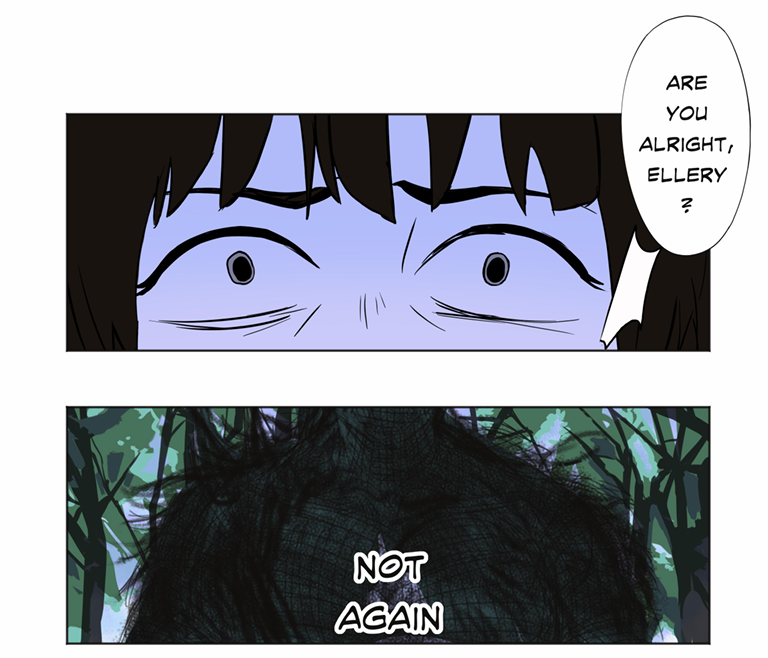
When I first read Little Death, I was astonished at my own visceral reaction to it. I’m not a novice to art that is dark, taboo, trans, or any combination of the previous. In fact, I actively seek it out—indie queer fiction, taken from the sea of itch.io, smashwords, and bookfunnel; the depths of patreons, crowdfunders, and private Discord conventions; and from the mouths of friends whose names and genders I don’t know. The last time I read a top 50 bestseller in the past three years was when I bought the Merriam-Webster’s Collegiate Dictionary, the latest 12th ed. This isn’t a brag; I’m just giving context so you can get an idea of what kind of freak you’re getting a recommendation from.
Anyway.
It took me a long time to figure out why Little Death stuck in my head the way it did. I must’ve read it at least a dozen times front-to-back before I realized I was looking into a mirror. A mirror of uncomfortable truth. A mirror of what has plagued my heart since puberty.
It is difficult for me to describe my gender, and while I historically don’t have a terrible relationship with my body or dysphoria, I’d be lying if I said my chest and cute face didn’t cause me occasional, intense grief.
Ellery’s everything causes him grief. His body is his prison in a transphobic world that keeps him closeted, but grief also manifests from his mind. Haunted by nightmares and infiltrated with illusions, there is so nowhere that is safe. Not waking. Not sleeping. Not alone. Not among others.

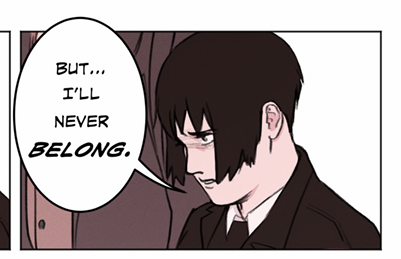
But it is through his body, this prison, that he can find salvation and freedom according to Callisto. I won’t attempt to explain Callisto for spoiler reasons, but what’s most important to understand is that the necromancer sees (or at least claims to see) Ellery for who he is—he won’t tolerate Ellery’s shame, his dysphoria, nor his disobedience.
If Ellery is ashamed of his breasts, Callisto will expose them for the world to see. If Ellery rejects his tender body’s arousal, Callisto will bring him to the brink until he begs for release.
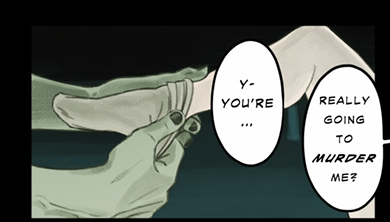
It is a sweet, delicious torment that hits a marginalized person where it hurts most: The idea that one will be loved and seen exactly as who they are, regardless of their own dysphoria, fears, shames, or regrets. Being forced to confront the scariest and most freeing feeling of them of all, acceptance, is a masterful feat that passes the bar of unconditional love.
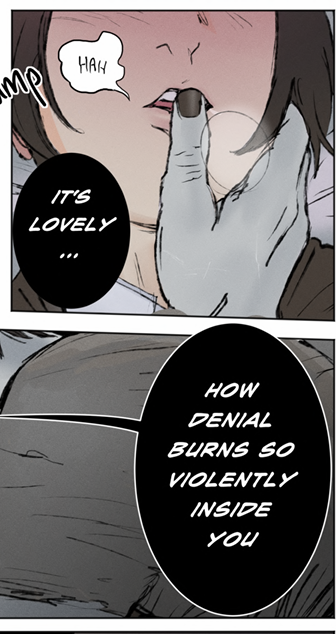
How can a story of a trans boy being tormented by a much older necromancer be unconditional love? Well, you’ll have to read and determine that for yourself if this unconditional love, or tough love, or cruel love, or not love at all.
For me, Little Death goes beyond being something sexy, fun, or engaging to read. It’s reflective. It sticks its skeletal fingers right where it hurts in my ribcage, feeling around vein and muscle, and forces me to confront emotions I’m uncomfortable with having. What does it mean to love myself unconditionally, rather than someone else and separate from something that is traditionally familial or romantic? Is loving myself another kind of torture if it means hugging all those unsavory parts? How might I live, as a queer person, if I was forced naked into a spotlight? What is missing and what do I yearn for? If people accepted me fully as I am right now, how would that fundamentally change who I am as a person? What would my life be like if I worried not about any perceptions?
What that looks like for Ellery I am intrigued to find out. For now, I am hoping to get Little Death volumes 1 and 2 printed on my bookshelf where no one can ever take it away from me. Whether they get torn, highlighted, damp, nicked, or burned, I will love and keep them… unconditionally.
If you’d like to join me, there are currently preorders for the books available on the Transgothica press webiste alongside links to digital. Here’s also a direct link to the volume 1 preorder, the volume 2 preorder, and the alternate cover volume 2 preorder.
Happy reading!
— Montero Thorne
Leave a Reply